The Rundown
Topics: Stage Directions, Terminology | 1 min read
If you do not have a background in theatre, stage directions can be quietly confusing. Terms like up stage and down stage get used constantly on site and rarely get explained.
They come straight from theatre, and they persist because they are unambiguous once you know them. Left and right mean nothing on a stage unless everyone agrees whose left is being discussed.
Knowing the correct terminology lets you give clearer instructions to production companies, presenters and crew - and understand what is being said back to you.
Here are the directions you will actually need, why left and right work the way they do, and the other terms worth knowing.
Up, Down and Mid
The Vertical View
In theatre, the stage is thought of as though it were vertical rather than flat. All the depth terminology follows from that.
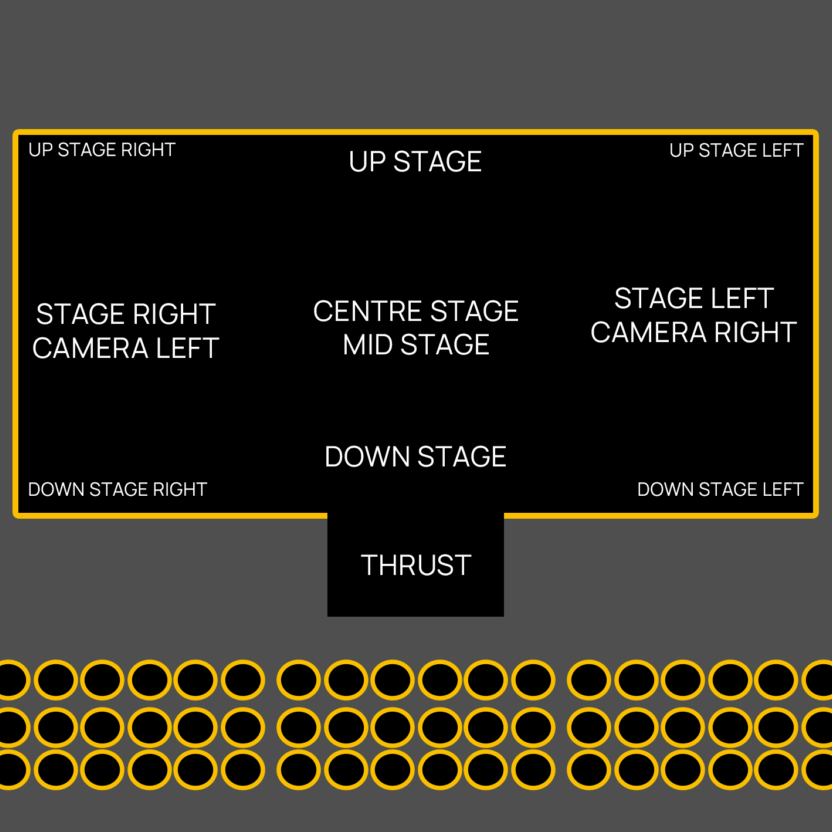
Up Stage
Towards the back of the stage, away from the audience.
Down Stage
Towards the front of the stage, closest to the audience.
Mid Stage
The middle, between the two.
Where It Comes From
The terms are a genuine leftover from raked stages, which were built physically higher at the back so audiences could see. Walking towards the rear literally meant walking up.
Almost no modern stage is raked, but the vocabulary stuck - and it remains more precise than back and front, which people interpret from wherever they happen to be standing.
Using It
Combine these with the lateral terms and you can specify any position on a stage in two words. Up stage right, down stage centre, mid stage left.
That precision is what makes it worth learning. Everyone involved arrives at the same point.
Left and Right
From the Performer's View
Lateral directions are always given from the performer's point of view, not the audience's.
Stage Left
The performer's left, which is the audience's right.
Stage Right
The performer's right, which is the audience's left.
This is the single most common source of confusion on a show, and the reason the word stage is always attached. Saying just left to someone across the room is how presenters end up walking the wrong way.
Camera Left and Right
Some producers work from the camera position instead, particularly on broadcast or heavily filmed events.
Camera Left is the audience's left, the performer's right.
Camera Right is the audience's right, the performer's left.
They are the exact inverse of stage directions, which is precisely why mixing the two systems on one show causes problems.
Agree One System
Whichever convention the production is using, establish it early and use it consistently. The error is almost never that someone does not understand the terms - it is that two people are using different sets.
Other Terms
Thrust
A catwalk-style piece of staging that protrudes forward from the front of the stage into the audience.
Common at fashion shows and increasingly at conferences, where it brings a speaker physically closer to the room.
Wings
The parts of the stage not visible to the audience, to either side and usually concealed by fabric drapes, known as tabs.
The wings are where presenters wait, where the stage manager works, and where anything that needs to appear quickly is stored. Their size matters more than people expect when planning a layout.
Tabs
The drapes themselves. Also used for the main curtain in a traditional theatre.
Why It Is Worth Learning
None of this is complicated, and a working knowledge removes a surprising amount of friction on a build day.
Clear direction means fewer repeated instructions, fewer people in the wrong position, and a technical team that can act on what you say without translating it first.
Planning a Stage?
If you need help with stage design, or working out how a layout fits your space, get in touch with Premier Live on 0116 202 9953 or info@premier-ltd.com.
Tell us about your event.
Fill in the form and we'll come back to you quickly, not with a generic auto-reply, but with something useful.
Prefer a call? Book a 20-minute discovery call at a time that suits you.
Rather email? info@premier-ltd.com. Or just ring us: 0116 202 9953.
Once we hear from you, we'll set up a quick call to understand your brief properly, no lengthy questionnaires, no sales pitch.
We typically respond within two hours on working days.
EXPERIENCED. DEPENDABLE. HANDS-ON. UNFLAPPABLE
The people behind Premier Live
These are our people - the production managers, technicians, show-callers and crew who plan your event and run the room on the night. The same team from first site visit to final cue.

What We've Been Up To.
A look at the events we've delivered, the brief, the build, and how it ran on the night. Worth a read.