The Rundown
Topics: Video, Event Technology | Published: February 2022 | 4 min read
Video screen covers several genuinely different technologies, and the words used to describe them overlap in unhelpful ways. An LED TV and an LED wall share a name and almost nothing else.
Getting the choice wrong is expensive. Specify a projector for a bright room and the image disappears. Specify an LED wall where a flat panel would do and you have paid for rigging, three-phase power and a specialist crew you did not need.
The right screen depends on size, ambient light, viewing distance and what the venue will physically allow.
Here is what each type actually is, and where it earns its place.
Displays and Panels
LED, LCD and OLED
Modern flat screens are variations on one idea. An LED TV is a specific type of LCD TV - properly an LED-backlit LCD - but nobody says that out loud.
The panel is two sheets of polarising material with a liquid crystal solution between them. Passing current through the liquid aligns the crystals so light either passes or does not. Think of each crystal as a shutter.
A decade ago you could buy LCD panels backlit other ways. Those have largely disappeared: less efficient, less contrast, bulkier.
OLED works similarly but uses organic LEDs in a thin sheet rather than individual pixels soldered to a board, which makes the panel much thinner. It is more common in consumer screens than commercial ones - the panels can be fragile and the technology is less proven in the punishing conditions of a touring event.
Plasma
Plasma was the original flat screen, dominant through the late nineties and early 2000s before LED backlighting overtook it in the 2010s.
Some people still prefer the picture, arguing it looks more natural. The drawbacks are hard to ignore: heavy, bulky, fragile, and prone to screen burn - a bright static image left too long leaves a ghost of itself permanently.
For events, plasma is history rather than an option.
LED Walls
A Different Thing Entirely
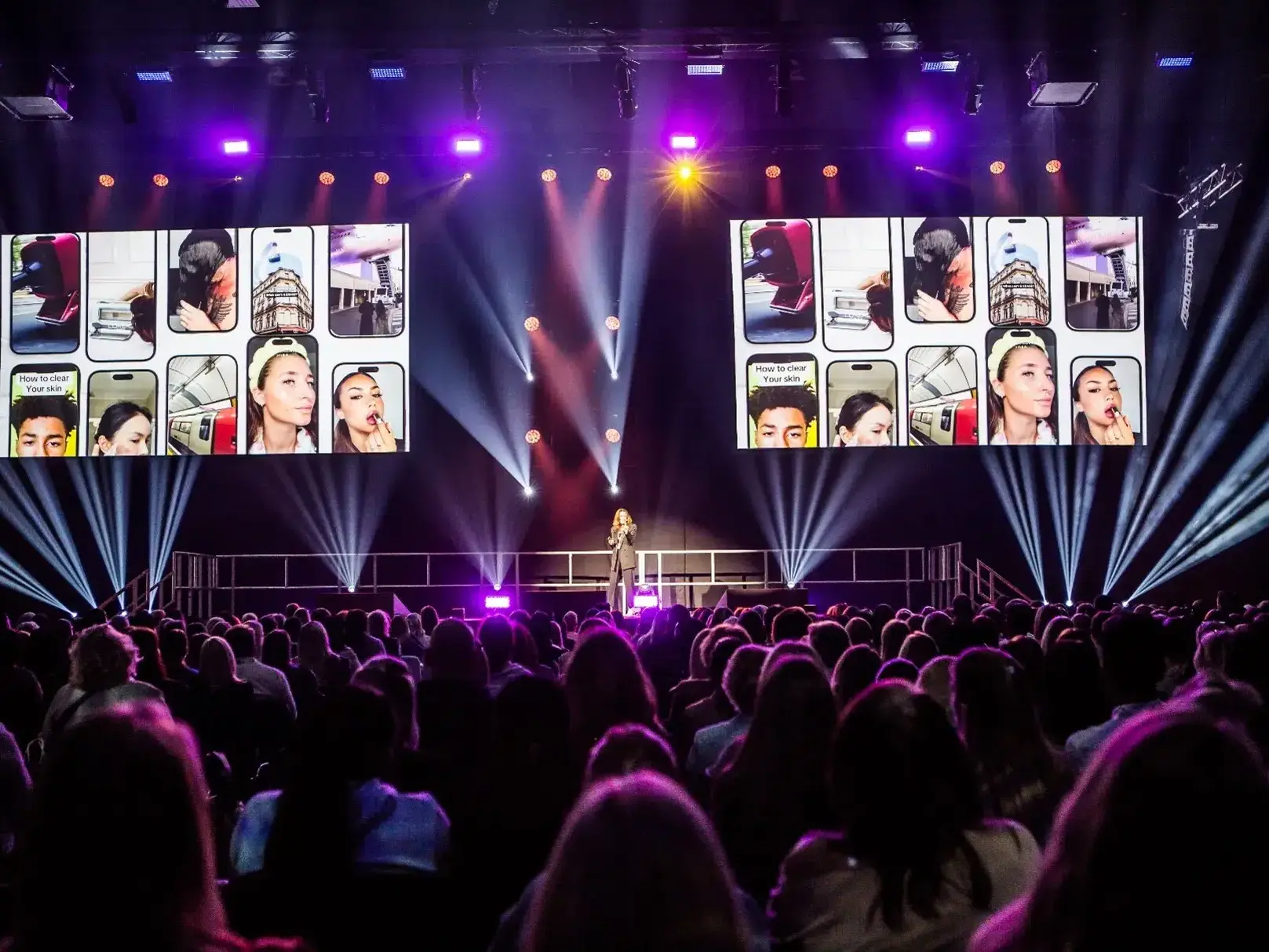
Confusingly, LED screen also describes large-format LED walls, which have nothing in common with an LED-backlit TV.
Flat panels top out around 2m across. LED walls only start making sense above that, which is why they belong to a different conversation.
How They Are Built
A wall is assembled from seamless panels, typically 0.5m to 1m wide, locking together into a larger surface. It can be flown from the ceiling or ground-stacked depending on the venue.
The pixels sit much further apart than on a TV, and panels are classified by that gap. A P3 wall has pixels 3mm apart. For comparison, a 40-inch consumer TV is around 0.5mm. Lower number, higher density, sharper close-up image.
Why They Have Become Viable
LED walls have existed for decades but were long confined to festivals and arenas, where P12 or coarser was acceptable because nobody stood close.
Falling component costs have changed that. P3 and finer are now realistic for exhibitions, awards shows and conferences - rooms where the audience is near the screen.
The Trade-offs
They are extremely bright, buildable to almost any size or shape, and some can curve. Against that: cost, the need for skilled technicians to set up and operate, and rigging requirements that not every venue can accommodate. Check the venue before you commit to the design.
Projection and Older Formats
Projection
The staple of smaller events, and familiar to most people. A bright image is thrown onto a surface, from the front or from behind.
The appeal is cost. At modest scale, projection is inexpensive and needs relatively little equipment.
The limitations are physical. Ambient light washes the image out, so a well-lit room is a poor candidate. And the projector needs clear line of sight to the surface - anything in the path, including people, puts a shadow on your content.
Rear projection solves the shadow problem but needs depth behind the screen that many venues do not have.
CRT
Cathode Ray Tube screens are the old televisions: heavy glass in a deep box, standard until the 21st century.
They have been surpassed on quality and price by everything above. A small group of enthusiasts and graphic designers still favour high-end CRT for its colour rendition and contrast, and they make an excellent period prop if a set calls for one.
Choosing
Start with the room. How big does the image need to be, how bright is the space, how close is the nearest viewer, and what can the venue physically support?
For advice on what suits your event, get in touch with Premier Live.
Tell us about your event.
Fill in the form and we'll come back to you quickly, not with a generic auto-reply, but with something useful.
Prefer a call? Book a 20-minute discovery call at a time that suits you.
Rather email? info@premier-ltd.com. Or just ring us: 0116 202 9953.
Once we hear from you, we'll set up a quick call to understand your brief properly, no lengthy questionnaires, no sales pitch.
We typically respond within two hours on working days.
EXPERIENCED. DEPENDABLE. HANDS-ON. UNFLAPPABLE
The people behind Premier Live
These are our people - the production managers, technicians, show-callers and crew who plan your event and run the room on the night. The same team from first site visit to final cue.
























What We've Been Up To.
A look at the events we've delivered, the brief, the build, and how it ran on the night. Worth a read.